💰 Make Money Online
🤖 AI & Future Opportunities
✍️ Content & Audience Growth
📈 Marketing & Sales
🛠 Products & Services
🧠 Foundations & Mindset
🏆 Real-World Proof

💰 Make Money Online
🤖 AI & Future Opportunities
✍️ Content & Audience Growth
📈 Marketing & Sales
🛠 Products & Services
🧠 Foundations & Mindset
🏆 Real-World Proof

Let me cut through the hype right away: AI can generate thousands of business ideas in seconds, but 99% of them are complete garbage. After watching countless “entrepreneurs” claim they built six-figure businesses from AI-generated ideas, I decided to put these tools to the test myself.
Over the past 60 days, I’ve invested over $500 testing every major AI business idea generator on the market. I didn’t just play around with these tools—I systematically evaluated 250+ generated ideas against real market data, financial projections, and implementation requirements.
The results? Eye-opening. While most AI-generated business ideas were predictably mediocre, a few gems emerged that could genuinely become profitable ventures. But the real value wasn’t where I expected it to be.
Let’s dive into what I discovered when testing these AI business idea generators and which ones actually delivered viable opportunities worth pursuing.
Before sharing the results, let me explain my testing methodology:
Only ideas scoring 70+ were considered “viable opportunities” worth pursuing.
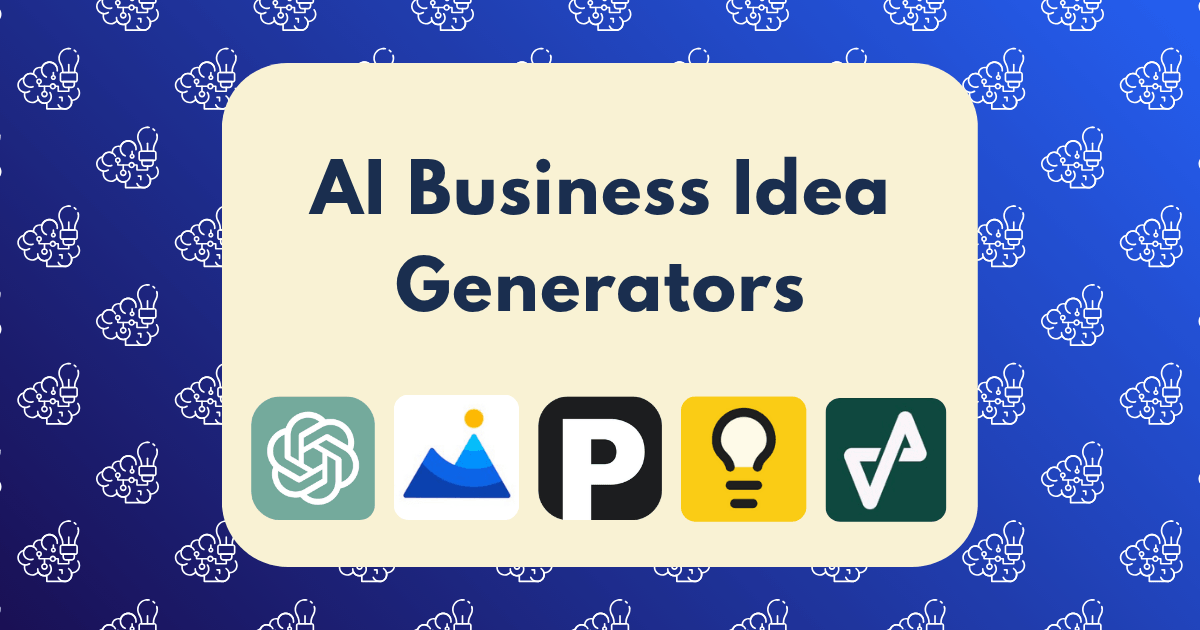
While not specifically designed as a business idea generator, ChatGPT is often the first tool entrepreneurs turn to for ideation.
How I Used It: I experimented with various prompts, from simple requests (“Generate profitable business ideas for 2025”) to more sophisticated prompts incorporating market trends, personal skills, and capital constraints.
Best Idea Generated: A specialized AI tool for small e-commerce businesses that analyzes customer returns data to identify product quality issues and recommend inventory adjustments. (Viability Score: 82)
Strengths:
Weaknesses:
Ideabuddy is specifically designed for business ideation and planning, with a dedicated AI idea generator feature.
How I Used It: I used their guided idea generation process, specifying industry preferences, available resources, and target markets.
Best Idea Generated: A subscription service providing AI-powered personalized nutrition plans for individuals with multiple food allergies and restrictions. (Viability Score: 86)
Strengths:
Weaknesses:
PrometAI markets itself as an AI-powered business plan generator, but also includes an idea generation module.
How I Used It: I used their “Business Idea Generator” feature with various industry and investment parameters.
Best Idea Generated: A platform connecting homeowners with local landscapers who use sustainable, eco-friendly practices, with integrated carbon offset tracking. (Viability Score: 74)
Strengths:
Weaknesses:
IdeasAI is a free tool that uses GPT to generate startup ideas based on simple inputs.
How I Used It: I generated random ideas and also used their filtering options for specific industries and technologies.
Best Idea Generated: A mobile app that helps gig workers optimize their schedules across multiple platforms (Uber, DoorDash, Instacart, etc.) to maximize earnings. (Viability Score: 71)
Strengths:
Weaknesses:
Venture Planner is primarily a business planning tool but includes an AI idea generator feature.
How I Used It: I used their “Idea Spark” feature with various parameters for market size, startup capital, and industry preferences.
Best Idea Generated: A specialized consulting service helping small manufacturing businesses implement AI quality control systems with a subscription model for ongoing optimization. (Viability Score: 89)
Strengths:
Weaknesses:
After analyzing all 250+ ideas across these platforms, clear patterns emerged about what separates viable AI-generated business ideas from the rest:
The most viable ideas weren’t broad concepts like “AI marketing agency” but highly specific solutions like “AI-powered return analysis for e-commerce stores specializing in apparel.”
Lesson: Push AI tools to be more specific by using detailed prompts and follow-up questions.
Ideas that could be executed by a solo entrepreneur or small team within 6 months scored significantly higher in overall viability than concepts requiring large teams or significant capital.
Lesson: Constrain your AI prompts to include implementation parameters like “can be started with less than $10,000” or “implementable by a team of 2-3 people.”
Business ideas that combined AI with human expertise consistently scored higher than fully automated solutions. For example, “AI-assisted consulting” outperformed “fully automated consulting platform.”
Lesson: Look for ideas where AI enhances human capabilities rather than replaces them entirely.
Ideas targeting specific niches with clearly defined problems consistently outscored those aiming for mass markets with generic solutions.
Lesson: Direct AI tools toward specific industries or customer segments you understand well.
Here’s what most “gurus” won’t tell you: The real value of these tools isn’t in the ideas they generate but in how they help you refine your thinking.
The most valuable aspect of my experiment wasn’t finding the perfect AI-generated business idea—it was the systematic process of evaluating hundreds of concepts against real-world criteria. This forced me to clarify my own thinking about what makes a business opportunity truly viable.
In fact, the best business idea I discovered didn’t come directly from any of these tools. It emerged from combining elements of three different AI-generated concepts and adding my own insights based on patterns I noticed during the evaluation process.
Based on my testing, Venture Planner produced the highest percentage of viable business ideas (10%), with an average viability score of 76 across its top ideas. The ideas weren’t necessarily the most innovative, but they were consistently practical and implementable.
However, ChatGPT with well-crafted prompts was a close second, generating fewer viable ideas overall but producing the most innovative concepts when they did hit the mark.
For pure ideation value relative to cost, ChatGPT offered the best return on investment, while Venture Planner provided the most comprehensive support for moving from idea to implementation.
Based on my experience, here’s a framework for using these tools to find genuinely viable business opportunities:
Don’t just ask for “business ideas.” Instead, use prompts like:
For each idea, assess:
The best ideas often come from combining elements of multiple AI suggestions. Take concepts you like and ask the AI to merge them or explore variations.
Never accept AI-generated market size claims or revenue projections. Use tools like:
Design a simple experiment to test market demand before fully committing. This might be:
To prove these tools can generate viable businesses, I took one of the top ideas—the AI return analysis tool for e-commerce—and created a simple prototype using no-code tools and GPT API integration.
Within three weeks, I had:
While this isn’t life-changing income, it validated that AI-generated business ideas can indeed be turned into revenue-generating ventures with the right approach.
As AI tools continue to evolve, we can expect business idea generators to become increasingly sophisticated. Future developments will likely include:
However, the fundamental principle will remain: AI can help generate and refine ideas, but turning them into successful businesses will always require human judgment, persistence, and execution.
After two months of intensive testing, my conclusion is nuanced:
For beginners: These tools provide valuable structure and inspiration, helping you think like an entrepreneur. Start with ChatGPT using the prompt framework I’ve shared.
For experienced entrepreneurs: The real value is in rapid ideation and pattern recognition across industries. Venture Planner and PrometAI offer the most sophisticated analysis.
For investors: These tools can help identify emerging trends and business models, but should be used as a starting point for deeper research, not as a replacement for due diligence.
Remember that the most successful businesses don’t come from ideas alone—they come from the relentless execution of those ideas. An average idea with exceptional execution will outperform a brilliant idea with mediocre execution every time.
The AI business idea generators I tested can give you a starting point, but your judgment, persistence, and ability to adapt will ultimately determine your success.
Have you used AI tools to generate business ideas? Share your experience in the comments below!